
State Bank Foundation Institute (Chetana) - the fifth apex training institute of State Bank of India - will be inaugurated tomorrow at Indore.. It has been set up to groom new officers as future leaders..
Showing posts with label Buzz. Show all posts
Showing posts with label Buzz. Show all posts
Sunday, July 24, 2011


Thursday, February 17, 2011
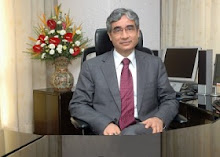
Mission Accomplished
By Abhijit Lele
Despite his run-ins with RBI, the State Bank of India chairman has managed to keep the public sector behemoth ahead of peers

Despite his run-ins with RBI, the State Bank of India chairman has managed to keep the public sector behemoth ahead of peers.
Despite his run-ins with RBI, the State Bank of India chairman has managed to keep the public sector behemoth ahead of peers
'WHAT POWER DOES AN SBI CHAIRMAN ENJOY? IN ANY CASE, I AM A SIMPLE GADHWALI. NO ONE KNEW ME AND I DIDN'T HAVE ANY POLITICAL PATRONAGE, EITHER. SO, I COULD EASILY BE REMOVED IF I HAD DONE ANYTHING WRONG'
OM PRAKASH BHATT
Chairman, State Bank of India (At the World Economic Forum in Davos recently)
Despite his run-ins with RBI, the State Bank of India chairman has managed to keep the public sector behemoth ahead of peers.
The chairman’s angst sums up the public display of the uneasy relationship between the country’s largest bank — State Bank of India — and the Reserve Bank of India (RBI), in the last couple of years over several issues, including the so-called teaser home loan rates (Bhatt, of course, has serious reservations over the term. He says he is not teasing anybody), higher provisioning coverage, guarantee to bonds issued by Tata Motors, etc. But more of that, later.
Even his worst detractors can’t deny that Bhatt, who is due to retire in March after a five-year term, has been able to turn SBI from a lethargic elephant to one that can dance.
When he took over the reins in June 2006, the usual lament about SBI was: “It is too slow and past its prime. Soon, the nimble-footed private banks will go ahead.”
The numbers supported this argument. ICICI Bank was a serious threat.
In June 2006, SBI’s total business stood at Rs 639,817 crore. ICICI, though behind, was closing in with a much faster growth rate. Its total business stood at Rs 330,490 crore. Analysts assumed it was only a matter of time – may be, another five years – before the private sector bank became the number-one bank in the country.
Bhatt’s appointment wasn’t a smooth affair, either. Yogesh Agarwal, then managing director of State Bank of Patialia, was considered a strong contender for the top position. But Bhatt pipped him to the post. Though Agarwal became the managing director of SBI in October, he moved to head IDBI Bank in July 2007.
Internally, the bank was grappling with many issues. For one, it had serious software problems that were not allowing it to roll out core banking solutions. This had to be addressed on a war footing, since core banking solutions were the backbone required for any scaling up and offering value-added services to corporate clients. Bhatt evaluated the situation for the first three months. Then, he asked the software vendor, Tata Consultancy Services, to rectify the glitches.
Then, the business process re-engineering process plan was started at branches. This involved training every staff and redesigning the layout of branches to make work a little better, faster and cheaper.
He put in place capital-raising plans to support growth for the next four-five years. SBI raised Rs 16,000 crore in March 2008 through rights issue. At present, the bank has been working on another rights issue to raise about Rs 20,000 crore by March. Banking analysts say this capital should support its growth plans for another five years. “SBI has recorded a consistent growth in business in the last four years. The credit to deposit ratio of 77 per cent indicates efficient deployment of resources,” said D R Dogra, managing director of ratings agency CARE.
Other important measures include an aggressive focus on the retail customer (the introduction of teaser loans being one such example); Parivartan I and II — programmes for employee motivation and skill set improvement; Udan — preparing a pipeline of future leaders at both senior and middle levels. These have improved the perception of SBI among both peers and analysts.
He resumed clerical recruitment, which had been frozen for over a decade, in view of growing business. Importantly, the process of consolidation within the SBI associates was started. He merged State Bank of Saurashtra and State Bank of Indore with SBI. “This will improve the bank’s operating efficiencies,” added CARE’s Dogra.
Many, however, say the SBI chairman could have handled his relationship with the regulator with a little more finesse. “He could have easily avoided the in-your-face and aggressive approach with the regulator. That had to deal with the banking industry as a whole,” said an observer.
But Bhatt remains adamant and says he has done nothing wrong. “Many Indians own homes because of SBI. I am not fighting with RBI, but only clarifying... we only gave discount on the rate for the first two-three years and at higher than the cost of my funds. So what is wrong in what SBI does?” Bhatt said, while admitting that there were quite a few other issues on which he “differed” with the regulator.
Besides the teaser loan, the bank faced regulatory ire for guaranteeing Tata Motors’ debenture issue of Rs 10,000 crore and overall provisioning of 70 per cent for bad loan portfolio.
The empire struck back. RBI was highly critical of the bank’s performance, including its financial health. Consequently, it downgraded the bank’s CAMEL (capital, asset quality, management, earnings, liquidity and systems and control) ratings from B to B- in an internal report for the year ended March 2009.
There were internal rumblings too. When Bhatt restructured operations at state-level units, popularly known as circles, by dismantling a decision-making layer (zone) headed by deputy general managers, there was again a lot of criticism. While work would be sped up by cutting on red tape, it put immense pressure on general managers. The jury is out on whether or not this has made the bank more efficient.
A top official of the bank, under condition of anonymity, says: “Bhatt has improved the bank’s image and introduced aggressiveness. The performance, in terms of market share, speaks for itself.”
In the same breath, however, the official admits that the down side of his leadership style has, perhaps, weakened the collective decision-making culture at SBI.
The good news: SBI continues to be at the top of the table. In December 2010, SBI’s total business stood at Rs16,19,950 crore, compared to ICICI Bank’s Rs 424, 439 crore. Of course, ICICI Bank took a conscious decision to shrink its balance sheet size to manage the adverse effects of exponential growth and global financial crisis.
Jamal Mecklai, chief executive of Mecklai Financials, says: “During Bhatt’s regime, SBI has become more competitive in a market (like money and foreign exchange markets, and advisory services) where foreign banks and Indian private banks were very active. This helps expand the revenue base.”
The fear: His aggressive style may have compromised the bank’s standing with RBI. In addition, some of the asset quality, especially the restructured portfolio (part non-performing assets and part standard assets) may be concerns in the future and hurt profitability – a big challenge for the next chairman.
But on March 31, when Bhatt retires as chairman, he will have one satisfaction – no one calls SBI laid back anymore.
Courtesy: Business Standard
Friday, October 1, 2010
Project SMS Unhappy launched in Bhopal Circle..
Project SMS Unhappy launched in Bhopal Circle today..
CoolBisht / Indore
Tuesday, September 21, 2010
Unhappy with SBI? Just send an SMS
By SWATI BHARADWAJ-CHAND and PADMINI COPPARAPU,TNN
HYDERABAD: When Vijayawada-based Vijaya Prasad walked into his bank branch for a gold loan only to be rudely turned away by the clerk behind the counter, all he did was shoot off a one-word SMS to his bank ‘Unhappy’.
Within minutes, not only did he get a call from the bank’s call centre, the branch manager personally sought him out and cleared his gold loan in just one hour flat. Over 16,000 disgruntled bank customers like Prasad have found to their delight that one SMS did for them what months of running around from one bank branch to the other could not.
But these are no happy experiences of satisfied customers banking with swanky private banks. Hold your breath, this is a unique paperless and instant customer grievances redressal initiative being pilot-tested by the state-run State Bank of India (SBI) in Andhra Pradesh in a bid to don a customer-friendly avataar.
What’s more interesting is that SBI, which has for long been weighed down with an image of being a slow-moving ‘sarkari outfit’, has not only designed the software for the system in-house, it has gone one step ahead and filed for a global patent for the initiative branded as the ‘Unhappy Service’.
“We filed a patent for our ‘Unhappy service’ last month after extensive research indicated something similar had never been attempted anywhere in the world,” Diwakar Gupta, deputy managing director (national banking group), SBI,told TOI.
In fact, so impressed was SBI chairman O P Bhatt with it that he has decided to replicate it nationwide. The service is expected to go national by the end of the year.
Run out of an obscure looking, paperless room that sits in one corner of SBI's AP headquarters in Hyderabad, the ‘happy room’, as it is nicknamed, is the nerve-centre of SBI's happy customer drive. It is manned by a Happy Team' of just four SBI employees who resolve customer complaints filed through sms to a single number — 80082020202.
“We have resolved over 16,000 customer complaints pertaining to 1,100 SBI branches in AP with this service. Even customers from other states, who have dealings with any branches in the state, have got redressal through this service,” said Shiva Kumar, chief general manager, AP Circle, SBI.
Courtesy: The Economic Times
Tuesday, September 14, 2010
The Giant Starts Laughing..
Laughter Yoga Introduced In State Bank Of India


Laughter Cream

Appreciation Laughter
CoolBisht / Indore

Laughter Club of State Bank Learning Centre, Indore
The awakened Giant has now started laughing. Laughter Yoga has been introduced in the State Bank of India
A Laughter Club was formally launched today at the State Bank Learning Centre, Indore

Laughter yoga is an effective cardio workout and helps in staying fit. It increases blood circulation and relaxes muscles. Laughter yoga changes your mood within minutes by releasing endorphins in your brain. One feels energized and fresh throughout the day and can work more without getting tired. Laughter clubs provide a rich social network of people who care about one another. One learns to handle difficult situations effectively without losing composure by imbibing the essence of laughter yoga.
The club has been named as the Laughter Club of State Bank Learning Centre, Indore

Laughter Yoga Trainers Mrs Radhika Bisht and Mr Jagat Singh Bisht introduced laughter exercises to the participants. The founding members of the club are Mr Sabu P Simon, Mrs Harinaxi Sharma, Mrs Kamal Agrawal, Sarvashri Sanjay Keshwani, Rajesh Ladha, Narendra Gupta, R.C. Sisodiya, A.K. Sonara, B.R. Lambhate, Ravi Naramdeo, Anil Jain, Tejpal Khanna, Shishir Gwalherkar, Kamlesh Vishway, Sanjay Jain, Manoj Dusane, M.K. Purohit, Anil Bhatia, S.N. Dwivedi and Ajit Singh Chauhan.
Tuesday, August 31, 2010
Small Customers Are Daridra Narayana..

We treat all our customers equally. It's in our DNA. The small customers are the Daridra Narayana and we are the most happy to serve them.
O P Bhatt
Chairman
State Bank of India
Sunday, August 29, 2010
I am the least-paid Fortune 500 CEO: Om Prakash Bhatt
By Partha Sinha and Shubham Mukherjee
The State Bank of India broke into the Fortune 500 club during Om Prakash Bhatt's current five-year tenure as chairman — surely something to celebrate. And he is proud of the fact that not only did he get SBI there, but the bank has also been inching up a few notches with every passing year. However, there is something about that list which bothers him. He points out that he is the lowest-paid CEO on the Fortune 500 list. (The SBI chairman's compensation in the last financial year was Rs 27 lakh, while on an average a Fortune 500 CEO earns more than $10 million or Rs 47 crore a year).
The State Bank of India broke into the Fortune 500 club during Om Prakash Bhatt's current five-year tenure as chairman — surely something to celebrate. And he is proud of the fact that not only did he get SBI there, but the bank has also been inching up a few notches with every passing year. However, there is something about that list which bothers him. He points out that he is the lowest-paid CEO on the Fortune 500 list. (The SBI chairman's compensation in the last financial year was Rs 27 lakh, while on an average a Fortune 500 CEO earns more than $10 million or Rs 47 crore a year).
Maybe Bhatt has something to look forward to when he hangs up his boots as the top boss of the bank in March 2011. Being the head of the country's largest commercial bank, he would get a red carpet welcome from any financial services company in the private sector, which wants to fortify its position in the country and there would be a willing candidate in Bhatt. By his own admission, he cannot afford to retire on the pension of SBI. "I need to work to support my family," he says rather humbly over coffee in his rather spacious 18th floor office in Mumbai's central business district — Nariman Point. The building is like a fortress with two sets of checks and a barricade, designed to keep out a moving vehicle without credentials. And why not? It's the headquarters of the country's largest bank with a deposit base of over Rs 8 lakh crore and a turnover of Rs 86,000 crore.
His room has a lovely view of the Arabian Sea and parts of Marine Drive and there are at least three sets of room ACs to keep the temperature, of a place where some of the hottest decisions of the banking sector are taken, a little low. A replica of Krishna and Arjun at the battlefield of Kurukshetra rests on a table, perhaps reminding him of the continuous battle to keep his place under the sun. There are innumerable trophies which line a cabinet on one side of the room from the various battles won. Besides, there is a hockey stick, which adorns one wall —signed by the Indian hockey team which won the Asia Cup a few years ago.
Dressed in a black suit, looking every inch the proverbial banker, the 59-year-old from Dehradun, answers all the questions in a similar soft tone throughout the course of the two-hour-long chat. For a man, who brought in several changes to the public sector bank known to be slow but steady monolith, he was successful in hiding his tough and aggressive side. In fact, the tough banker appeared to be in a good mood as he is usually not known to be pinned down for such long chats.
Bhatt is not averse to taking tough decisions if it's for the long-term benefit of the bank's customers. Soon after he took over as SBI chief, for 90 days, he had put the implementation of the core banking solutions being implemented by TCS on hold. Only after the solutions were rejigged to make them more user-friendly for the bank's employees and customers, did he put the process back on track. The depth and reach of the bank that Bhatt runs can be gauged by the fact that while on one hand, SBI has an average car loan size of around Rs 3 lakh, recently it financed — in one day — over 100 Mercs for a group of businessmen in Aurangabad. "We also a financed a Rolls Royce last month," he quipped.
Similarly, while its average home loan is Rs 11 lakh, SBI has also financed homes which cost 10 times that amount. And due to its legacy, SBI treats all its customers equally. "It's in our DNA," Bhatt says in a matter of fact manner and for him, "the small customers are the Daridra Narayan and we are the most happy to serve them". His bosses in the Union finance ministry should be happy with the description as it fits in wonderfully with the government's larger goal of financial inclusion.
It's difficult not to notice the assortment of rings that adorn his fingers, perhaps keeping in balance all the planetary configurations of the time. And it sure appears to have paid off for Bhatt. Apart from transforming the largest bank in the country in less than five years, under him SBI won almost all the banking award in India. Clearly, Bhatt takes pride in his work. He showed us a video of a recent advertisement for the bank — twice — and took pains to explain its concept, at a time which was perhaps overlapping with his lunch break.
Courtesy: The Times of India
It would have been difficult for him to achieve what he has, if it was not for his leadership skills. One has to understand that since SBI is a government company, he did not have the luxury of paying anyone anything extra, give a bonus or offer an out-of-turn promotion. So, he had the unenviable job of keeping the employees motivated and grow the bank without offering anything tangible, except the passion of it all. "I spend about 40% of my time on staff. I listen to them, I spend time with them, at times for days. I brought in a specially designed module called 'Parivartan' which has increased employee efficiency."
Saturday, June 19, 2010
A new born citizen
Dear All
Want to share a very special moment in my life with all of you.Pl see the attachment.
With warm regards
Meenal Onkar
@Detroit, Michigan State,USA

Want to share a very special moment in my life with all of you.Pl see the attachment.
With warm regards
Meenal Onkar
@Detroit, Michigan State,USA

Wednesday, May 26, 2010
Co-creating Shared, Collective Experience of Citizenship Orientation Programme
Citizen SBI Workshop at SBLC, Indore on 24-25 May 2010


CoolBisht / Indore

Ms Saimah Khan, Probationary Officer, Bhopal Circle welcoming Mrs Vasudha Sundararaman, DGM Citizen SBI and expressing love and regards on behalf of all participants and facilitators from Ahmedabad, Bhopal, Chandigarh, Kolkata, Lucknow and New Delhi Circles and State Bank of Indore

Mr J S Bisht, Programme Co-ordinator discussing a point with the DGM, Citizen SBI just before the beginning of the workshop

DGM, Citizen SBI addressing the participants at the beginning of the workshop

Participants listening intently to the DGM, Citizen SBI

The Joy of Co-Creation - Group photograph of the participants with Mrs Vasudha Sundararaman, DGM Citizen SBI, Intervention Leaders Mr Balachandra Bhat (Chennai), B K Dash (Bhubaneswar), J S Bisht (Bhopal) and R Natarajan (Guwahati) and Ms Sabina Sheoran, Management Trainee, Corporate Communication and Change Department
CoolBisht / Indore
Friday, April 9, 2010
Social biz is the new fusion buzz
Can Alcoholics Anonymous (AA) be turned into a profitable business venture? Or, can Mumbai-based Party Hard Drivers (PHD), the first company in the country to specialise in providing drivers by night so that people do not drink and drive, be called “social business’’?
As cathedrals of capitalism tottered on the brink of fiscal chaos following the Lehman collapse, high priests of socialism began pushing their ideology. Now, with the economy reviving, there are once again talks of fusion of the two “isms’’. There is a section of ideators that thinks several philanthropic efforts, if treated as “social business’’, can become profitable and have high welfare impact.
“Social business’’ is a term used by Nobel laureate and maestro of microfinance Muhammad Yunus to describe a commercial activity where businesses whose primary goal is to help the targeted group plough their entire profits back into their work rather than give dividends to shareholders. According to Yunus, a social business enterprise is created not to maximise profits, but with a declared mission to maximise benefits to the people served, without incurring losses.
It has become fashionable for some corporates to pontificate on corporate social responsibility (CSR), which social entrepreneurs call more of a PR exercise than a genuine effort to help the poor. As companies increase allocations for CSR activities and begin targeting the bottom of the pyramid, social business is gaining currency.
While addressing industry leaders in Mumbai recently, Yunus, who pioneered microfinancing, said: “We, as humankind, have multidimensions: We have selfless parts and we have a self-centred part. Most of the businesses today are focused on the self-centred part. It is all about me, it is all about my. The social business is all about you. The objective of social business is not to maximise profit, but to get maximum social benefits.’’
The founder of Bangladesh’s Grameen Bank also proposed setting up a separate stock exchange for the listing of social enterprises as one of the funding sources for such firms. “The social business is not charity as it can be run through raising funds from the stock market. In the Indian context, social business can be possible in a number of areas such as water, health, urban poverty, education and environment,’’ Yunus said.
There are some takers for Yunus’s proposal. Says Nishith Desai, founder of Nishith Desai Associates, a Mumbai-based international law firm, “If Alcoholics Anonymous (AA), for example, becomes part of the social business venture, raising funds and scaling up operations will not be a problem for it and it will turn into a profitable enterprise.’’ Desai said AA, if structured as a social business enterprise, could offer services under three slabs: some free of cost, some at lower rates and others at significantly higher rates.
The “customers’’ of AA —the relatives of the persons using the services of AA—could invest in AA even as their kin gets rid of alcoholism, thereby making it financially viable. Likewise, Party Hard Drivers, too, can scale up operations, as part of the social business model.
India Inc is warming up to the idea of social business. Yunus recently told TOI that some Indian companies have agreed to team up with Grameen Bank for the social business venture on the lines of JVs with French foods major Groupe Danone and German sports apparel group Adidas. Grameen joined hands with MNCs to create social businesses. One of the first such JVs was with Danone in 2006. “In Bangladesh, nutrition is a big challenge. Here’s where skill and technology come in. Danone has great expertise on how to make delicious yogurt. We figured out that to solve this problem of malnutrition, we need to put micro-nutrients into yogurt and try to make it as cheap as possible for the real target group that needs it,” Yunus said. The Grameen-Danone effort has reduced malnutrition among the children of Bangladesh, he said. The metric of the success of this company is not the amount of profit generated but the number of children escaping malnutrition, Yunus said.
The Grameen Group, which is mainly into rural credit, has also tied up with Adidas for low-cost shoes for the poor as part of the social business venture. Adidas has produced shoes that costs under $2 a pair and will be shipping 10,000 pairs as samples to Bangladesh for testing before initiating regular production.
Earlier, Grameen had entered into JVs with French major Veolia for clean water and Germany’s BASF to produce chemically-treated mosquito nets. Grameen has also tied up with Germany’s top chain store Otto to set up a garment factory.
According to Venkat Krishnan of GiveIndia, a donation platform, the social business model will have mixed motives. “The challenge will be to strike the right balance between social good and maximising profit. Prof Yunus has been able to achieve that in the case of Grameen Bank.’’ Krishnan agrees that if India Inc is able to create a structured social enterprise, raising funds for philanthropic work will become easier. “The problem will arise when greed capitalism begins to overtake benevolent capitalism,’’ he adds.
Reema Nanavati, director, Self Employed Women’s Association (SEWA), the largest labour union of informal sector workers in India, said they have been practising the social business model for the past eight years. “From textiles to rural infrastructure, SEWA runs businesses where marginalised communities are the shareholders as well the managers. Fifty per cent of the profit is ploughed back into the business and the remaining 50% is passed on to the shareholders,” she said.
SEWA has tie-ups with Hero Honda, ITC and Bajaj Electrical among others.
Over the years, though CSR initiatives have become an integral part of a corportate strategy, critics say not enough is being done. Says Desai: “Once the social business idea takes off, NGOs will not have to go around with a begging bowl for funds. Today, charity is a one-time transaction. You write a cheque and feel your responsibility is over. In social business, sustainability is the key, which leads to self-reliance. The involvement of the donor is a long-term effort.’’
courtesy: timesofindia.com
Monday, April 5, 2010
SBI customers can get it done with 'SMS Unhappy'
By G. Naga Sridhar
Hyderabad: Mr G. Venkatram wanted a gold loan to meet an emergency expenditure from a State Bank of India (SBI) branch. But the clerk told him to come after two days, as he was busy.
Immediately Mr Venkatram sent an SMS to the SBI Head Office stating that he was “unhappy.” Within minutes, he received a call from the branch manager and the loan was sanctioned.
This is an example to highlight the efficacy of the SMS Unhappy service launched by the SBI in Andhra Pradesh.
“When we launched this in December 2009, many thought it was just hype. But we proved them wrong, by solving 71 per cent of the problems of the customers within 48 hours. This disposal rate is very rare in the industry,” Mr Shiv Kumar, Chief General Manager, told Business Line.
This is a portal-linked service, which enables a dissatisfied customer to SMS “unhappy” to 8008202020, which is connected to a “happy room” at the SBI Head Office.
Within minutes, the customer will receive a call from the Head Office.
So far, the bank has received 7,865 unhappy messages (complaints), out of which 6,990 have been resolved, officials said. A majority of the complaints pertain to ATM transactions and clearance-related matters.
“Interestingly, the system is also serving the purpose of getting valuable feedback from customers. Any kind of matter can be brought to our notice with an SMS,” he said.
All the branch managers will get pop-ups on new or pending complaints in their branch.
This keeps the staff on their feet to address problems, officials said. Once a complaint is addressed, the branch head is expected to send that in writing to the portal, which will then be updated.
“Nobody except the people concerned in the Head Office can meddle with the complaints or delete them. Our staff checks with the customers before closing the complaint,” Mr Kumar said.
Expand service
In view of the “huge success” of the service, SBI is likely to replicate the system across the country.
“However, it is up to the corporate office to decide,” said the official who first thought of the system in 2008, when he was serving in Bhubaneshwar.
“I wish all banks will adopt similar transparent systems of complaint redressal. I thank SBI for this,” reads a message sent by an elated SBI customer.
These kind of “happy messages” abound on a monitor at the SBI office.
courtesy: The Hindu Business Line
Tuesday, March 30, 2010
Enlightened Citizenship
A Treasure-Trove
A Must Visit Website

Illumine has launched a website on Enlightened Citizenship. This is an attempt to invite people into the shared space of enlightened citizenship.
The spiritual and philosophical pillars of enlightened citizenship were laid down by Swami Ranganathananada. The website provides his extensive biography and a rich glimpse into his works.
Enlightened Citizenship is a treasure-trove of writings and talks of Mr V Srinivas - the founder CEO and lead researcher of Illumine - who has been deeply engaged in actualizing Swami Ranganathananda's "Science of Human Possibilities" in the form of constructs, knowledge tools, and institutional models. He believes that this translation will enable different segments of society to realize the promise of this new science in their day-to-day life.
The website is a compendium of a series of Foundation Notes bringing out the nuances of the enlightened citizen ideal.
Enlightened Citizenship is one of the most potent weapons we have to fight corruption and apathy in our public services. Accordingly, the website contains valuable interpretive presentations of Swami Vivekananda, Swami Ranganathananda and Mr Srinivas on enlightened citizenship and public administration.
It has also a whole section dedicated to enlightened citizenship and education as one of the critical challenges facing us is embedment of Citizenship Thinking in tomorrow's India (our students and children).
The website also provides a window to Project Citizen SBI - a gigantic transformative exercise of India's largest Bank.
The site is anchored by Mr V Srinivas and managed by Illumine Lab Communications - a division of Illumine Knowledge Resources. It may be reached at http://www.enlightenedcitizenship.org/
The CitizenSBI Blog congratulates Team Illumine for putting up this wonderful site of immense value in public domain and strongly recommends it to all our readers.
CoolBisht / Indore
Thursday, March 18, 2010
State Bank of Indore
Citizenship Orientation Programme
After completion of the Assistants to AGMs version of the citizenship orientation programme for State Bank of Indore, the programme is now being conducted for the subordinate staff at Indore, Bhopal and Gwalior. Here are two group photographs of participants presently attending programmes at State Bank Learning Centre, Indore. We shall be bringing you some moments of inner fulfillment from participants of these programmes soon.


After completion of the Assistants to AGMs version of the citizenship orientation programme for State Bank of Indore, the programme is now being conducted for the subordinate staff at Indore, Bhopal and Gwalior. Here are two group photographs of participants presently attending programmes at State Bank Learning Centre, Indore. We shall be bringing you some moments of inner fulfillment from participants of these programmes soon.


CoolBisht / Indore
Friday, March 12, 2010


Raja Releases Citizen Moments Book

Citizen Moments shared by the participants during Intervention -I have been compiled and published in Lucknow Circle. Mr N Raja, DMD and CDO released the book during his visit to Lucknow on 5th March 2010. Mr Balkrishna Vinayak Chaubal, CGM and Mr Arun Kumar Agrawal, GM(NW-2) were present on the occasion.

Courtesy: Mr Hem Chandra Karnatak, IL-1, Lucknow
Thursday, March 11, 2010
'Citizen SBI' In Second Phase
The State Bank of India's Chairman Mr O P Bhatt on bank's HRD initiative on conscious capitalism said, "After a successful nationwide programme 'Parivartan' in which all 2 lakh employees of SBI were involved, employees had demanded repetition of such a programme at the organization. And as a part of which our unique programme of 'Citizen SBI' was launched. It has completed first phase and next three phases will be over in about two years."
Mr Bhatt said this while delivering a keynote address, at the Conscious Capitalism summit organized by Confederation of Indian Industry (CII) and Conscious Capitalism Institute (CCI) in Mumbai today, on Large Scale Business Transformation: The 'Citizen SBI' Initiative.
He talked about the bank's initiative which is a part of its Corporate Social Responsibility and aims to enhance employees' self-awareness not only towards their work but in overall behavior and personality with inner sense.
Wednesday, March 10, 2010
CGM's Message
On reaching yet another milestone - 300 Blog Posts!

I am happy to know that the CitizenSBI Blog is actively sustaining the spirit of citizenship amongst fellow Citizens-SBI. As we evolve continuously, such sharing of views and information could reinforce and strengthen our commitment to shared values.
I extend my good wishes for the Blog to remain an active link among Citizens-SBI.
M Bhagavantha Rao
Chief General Manager
Bhopal Circle
Citizen SBI will change the social dynamics of India

“This programme is being run for two hundred thousand people across the Bank. We are trying to provoke them, ignite them in many ways. Our role is to constructively guide them in the right direction which will help them to reap more and more of the inner fruits, which will in turn help them to get more and more of the outer fruits. If the quality of interface between people at the Bank and customers changes, it is going to have some kind of cascading effect. If it happens to one person it is a big gain; if it happens to one hundred persons it is a huge gain; if it happens to two hundred thousand people in the organization, it will change the social dynamics of India because these two hundred thousand people interact with one hundred forty million customers.”
- Mr O. P. Bhatt, Chairman, SBI
Full article
This is the 300th post on CitizenSBI Blog
Tuesday, March 9, 2010
SBI is doing all that it takes to be an employer of choice
Raja says the mindset change is part of a carefully-crafted strategy that began with “Parivartan” (a 100-day programme to increase the communication skills of employees) and “Citizen SBI” — mammoth HR exercises that covered each of the 200,000 employees.
"Employer of choice” is not a branding that the country’s largest bank is used to. But it finally happened last month when the State Bank of India (SBI) figured in the list of the top 10 employee-friendly Indian organisations in a Business Today survey.
It was a surprise as the hurdles were many. The public sector legacy means that the SBI management’s hands are tied. The bank can pay only a fraction of what competitors do; promotions are still largely time-bound; long rural stints are a must; and recruitments are time-consuming — reasons that may be enough for critical talent to head for the exit door.
N Raja, deputy managing director of SBI, says a public sector bank has to learn to live with the constraints as its mandate is much beyond just making profits. But the attrition level, he says, is still well within single digits, though it’s something the bank is determined to bring down.
The bigger challenge, he says, is to attract the right kind of talent in specialised functions that SBI has got into: Private equity, treasury, risk management, general insurance etc. For example, the bank has been looking for a chief economist for some time now. But the available pool is small, and though the right candidates are enthused by the challenges that the job offers, the remuneration is a problem as SBI just can’t match competition.
But the bank is fighting back, and how. Even with a large employee base of over 200,000, business per employee has gone up from Rs 2.99 crore in 2005-06 to Rs 5.56 crore and profit per employee has more than doubled from Rs 2.17 lakh to Rs 4.74 lakh.
The process started when soon after taking charge, Chairman OP Bhatt held an offsite in Amby Valley, which resulted in documenting “The State of the Nation” — the bank’s strategy paper. Employees were then asked to document their vision for SBI. This set the ball rolling for the mindset change. Earlier, review meetings started with how SBI was losing market share to ICICI Bank and HDFC Bank. That changed to what SBI can learn from them and how it can beat them. But the idiom now is how SBI can hold on to its lead.
Raja says the mindset change is part of a carefully-crafted strategy that began with “Parivartan” (a 100-day programme to increase the communication skills of employees) and “Citizen SBI” — mammoth HR exercises that covered each of the 200,000 employees.
Last month, SBI did an HR audit — a first in its long history — and the feedback ranged from non-transparent promotion policy to rigid transfer rules. The bank brass is now burning the midnight oil to figure out how to redress these grievances.
The bank has also just set up a Strategic Training Unit (STU), monitored by Raja and headed by a chief general manager, so that training gets the due it deserves. The focus now is on how to improve the course content and the quality of faculty at its training institutes with outside help, if required.
The STU is doing several other firsts. Since leadership development is a focus area, SBI has tied up with the Indian School of Business to prepare a course module for chief managers and deputy general managers. “They are good, but the idea is to make them better,” Raja says. The duration of the course will be six months, in phases. The bank has also tied up with Duke University of the US, a leading executive education institute, for giving leadership training to general managers and chief general managers.
Another initiative of the STU is setting up of an elaborate e-learning platform. The bank offers 130 courses on its intranet at present, but the problem is that only 2,000 employees can log in to the system concurrently. The idea now is to have customised courses for each level of employees who can take online tests as well. The platform will be ready in six months, Raja says.
There’s more. Apart from the 120-odd B-school graduates (not the IIMs) that it plans to recruit for highly-specialised functions, SBI for the first time has recruited 500 Scale-II managers directly (probationary officers join in Scale-I after two years of training) for functions that require specialised knowledge. So, the overall knowledge levels of its officers are being scaled up gradually.
Raja agrees the pay scales are still not enough to attract top B-school graduates, but says that SBI doesn’t fare badly if overall cost-to-company (CTC) is taken into account. For example, CTC of a probationary officer is Rs 4.8-5.2 lakh if other facilities like free housing, medical reimbursements, furniture allowance etc are considered.
That doesn’t sound convincing enough as the gap with its private competitors on cash in hand is still very wide. For example, according to a recent advertisement, the bank is offering Rs 8.25 lakh per annum CTC for the post of chief manager (Risk Management System), the eligibility being that the person should have a minimum of 10 years experience. It’s certainly doubtful whether the money is enough to attract talent.
Overall, the elephant may not be dancing as yet, but it is surely shaking its leg to be in tune with the changing world.
Monday, March 8, 2010
For Better Citizens of Tomorrow
By Aditi Sharma
In Indore Plus (Sunday, March 7, 2010) - a supplement circulated with the Times of India and the Economic Times in Indore and adjoining cities


In Indore Plus (Sunday, March 7, 2010) - a supplement circulated with the Times of India and the Economic Times in Indore and adjoining cities


Subscribe to:
Posts (Atom)

 Posts
Posts


